


Bethyl Laboratories
Rabbit anti-RIF1 IHC Antibody Affinity Purified
Primary
Catalog #IHC-00203
TargetRIF1
HostRabbit
ClonalityPolyclonal
ReactivityHuman
ApplicationIHC
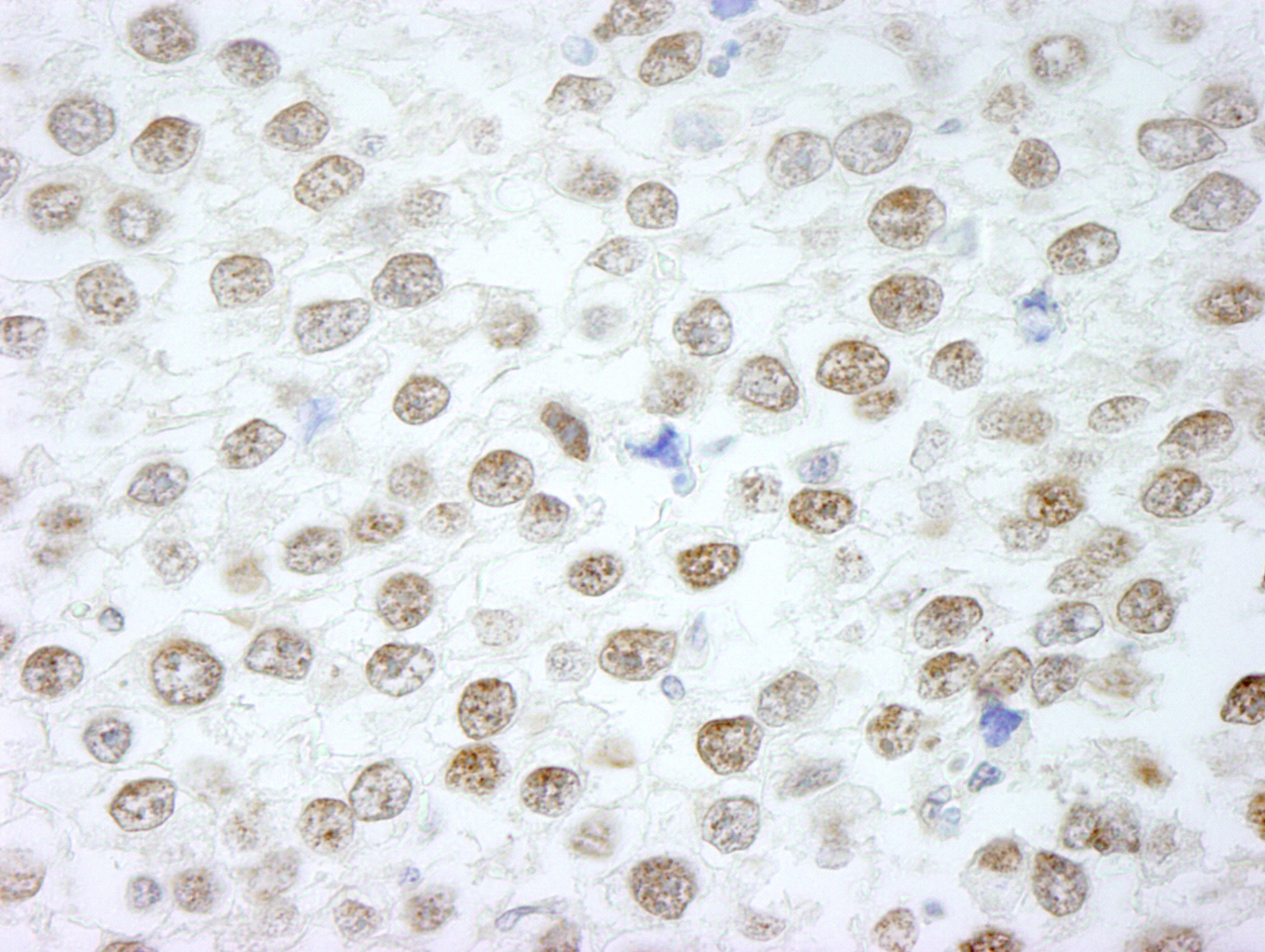
Image 1 of 1
local_shipping
Order within 13 hours and 57 minutes for shipment by Tuesday, November 17
Product Description
RAP1 interacting factor (RIF1) localizes to dysfunctional telomeres and functions in the S-phase checkpoint. In response to double-stranded breaks (DSBs), RIF1 functions in the ATM and ATR mediated response to DNA damage. RIF1 foci formation in response to DNA damage is completely dependent on ATM.
Specifications
Clonality
Polyclonal
Host
Rabbit
Immunogen
Between 2422 and C-terminus
Isotype
IgG
Reactivity
Human
Format
Whole IgG
Conjugate Type
Unconjugated
Purity
Antigen Affinity Purified
Concentration
250 µg/ml
Target Identity
TargetRIF1
Antigen Species
Human
Gene ID55183
Gene Symbol
RIF1
Gene Name
replication timing regulatory factor 1
Uniprot IDQ5UIP0
Protein Name
Telomere-associated protein RIF1
Product Information
Applications
IHC
Buffer
Tris-buffered Saline containing 0.1% BSA and 0.09% Sodium Azide
Storage Conditions
2 - 8 °C
Physical State
Liquid
Shelf Life
1 year from date of receipt
Country of Origin
USA
Production & Epitope
Antibody was affinity purified using an epitope specific to RIF1 immobilized on solid support.
The epitope recognized by IHC-00203 maps to a region between residues 2425 and the C-terminus (residue 2472) of human Rap1 Interacting Factor 1 using the numbering given in entry NP_060621.3 (GeneID 55183).
Applications
Epitope exposure is recommended.
Epitope exposure with citrate buffer will enhance staining.
Likely to work with frozen sections.
In some cases, the antibody may be diluted further than indicated.
Immunohistochemistry (IHC)1:100 - 1:500
Documents
Safety Data SheetPDF · IHC-00203Open
Product DatasheetPDF · IHC-00203 · Lot 1 (current lot)Open
Product DatasheetPDF · IHC-00203 · Lot 1 (current lot)Open
Services
Antibody Conjugation
Antibody and conjugate formats developed together, built to your specification.
Request CustomizationCustom Monoclonal Antibody Discovery Services
Full custom monoclonal development, from immunization through validation.
Explore Monoclonal DevelopmentVHH Discovery
Single-domain antibodies for structurally difficult targets a conventional monoclonal can't reach.
Explore VHH DiscoveryResources



1