



Bethyl Laboratories
Human bFGF ELISA KitNew
ELISA Kits
Catalog #E82-024
TargetHuman bFGF
ReactivityHuman
ApplicationELISA
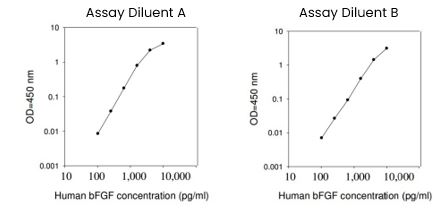
Image 1 of 1
local_shipping
Please allow 3-5 business days for shipment.
Product Description
FGF2 is a member of the fibroblast growth factor (FGF) family. FGF family members bind heparin and possess broad mitogenic and angiogenic activities. This protein has been implicated in diverse biological processes, such as limb and nervous system development, wound healing, and tumor growth. The mRNA for this gene contains multiple polyadenylation sites, and is alternatively translated from non-AUG (CUG) and AUG initiation codons, resulting in five different isoforms with distinct properties. The CUG-initiated isoforms are localized in the nucleus and are responsible for the intracrine effect, whereas, the AUG-initiated form is mostly cytosolic and is responsible for the paracrine and autocrine effects of this FGF.
Specifications
Reactivity
Human
Target Identity
TargetHuman bFGF
Gene ID2247
Gene Symbol
FGF2
Gene Name
fibroblast growth factor 2
Uniprot IDP09038
Product Information
Applications
ELISA
Assay Type
Sandwich ELISA
Assay Range
102.4 pg/ml - 10,000 pg/ml
Sample Type
Serum, Plasma, & Cell Culture Supernatant
Detection Method
Biotinylated-Streptavidin-HRP
Storage Conditions
2 - 8 °C
Shelf Life
6 months from date of receipt
Contents
- Human bFGF Pre-Coated 96-well Strip Plate, 1 each
- Human bFGF Standard vial, 2 each
- Human bFGF Detection Antibody
- Assay Diluent(s)
- Streptavidin-HRP Solution, 200µl
- TMB Substrate, 12 ml
- Stop Solution, 12 ml
- 20X Wash Buffer, 25 ml
- Sealing Tape, 2 sheets
Country of Origin
USA
Documents
Safety Data SheetPDF · E82-024Open
Product DatasheetPDF · E82-024Open
Services
Antibody Conjugation
Antibody and conjugate formats developed together, built to your specification.
Request CustomizationCustom Monoclonal Antibody Discovery Services
Full custom monoclonal development, from immunization through validation.
Explore Monoclonal DevelopmentVHH Discovery
Single-domain antibodies for structurally difficult targets a conventional monoclonal can't reach.
Explore VHH DiscoveryResources



1