



Bethyl Laboratories
Human IL-12 p70 ELISA KitNew
ELISA Kits
Catalog #E82-013
TargetHuman IL-12 p70
ReactivityHuman
ApplicationELISA
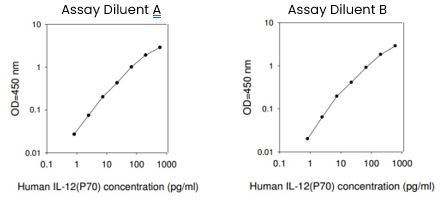
Image 1 of 1
local_shipping
Please allow 3-5 business days for shipment.
Product Description
IL12A encodes a subunit of a cytokine that acts on T and natural killer cells, and has a broad array of biological activities. The cytokine is a disulfide-linked heterodimer composed of the 35-kD subunit encoded by this gene, and a 40-kD subunit that is a member of the cytokine receptor family. This cytokine is required for the T-cell-independent induction of interferon (IFN)-gamma, and is important for the differentiation of both Th1 and Th2 cells. The responses of lymphocytes to this cytokine are mediated by the activator of transcription protein STAT4. Nitric oxide synthase 2A (NOS2A/NOS2) is found to be required for the signaling process of this cytokine in innate immunity.
Specifications
Reactivity
Human
Target Identity
TargetHuman IL-12 p70
Gene ID3592
Gene Symbol
IL12A
Gene Name
interleukin 12A
Uniprot IDP29459
Product Information
Applications
ELISA
Assay Type
Sandwich ELISA
Assay Range
0.8 pg/ml - 600 pg/ml
Sample Type
Serum, Plasma, & Cell Culture Supernatant
Detection Method
Biotinylated-Streptavidin-HRP
Storage Conditions
2 - 8 °C
Shelf Life
6 months from date of receipt
Contents
- Human IL-12 p70 Pre-Coated 96-well Strip Plate, 1 each
- Human IL-12 p70 Standard vial, 2 each
- Human IL-12 p70 Detection Antibody
- Assay Diluent(s)
- Streptavidin-HRP Solution, 200µl
- TMB Substrate, 12 ml
- Stop Solution, 12 ml
- 20X Wash Buffer, 25 ml
- Sealing Tape, 2 sheets
Country of Origin
USA
Documents
Safety Data SheetPDF · E82-013Open
Product DatasheetPDF · E82-013Open
Services
Antibody Conjugation
Antibody and conjugate formats developed together, built to your specification.
Request CustomizationCustom Monoclonal Antibody Discovery Services
Full custom monoclonal development, from immunization through validation.
Explore Monoclonal DevelopmentVHH Discovery
Single-domain antibodies for structurally difficult targets a conventional monoclonal can't reach.
Explore VHH DiscoveryResources



1