



Bethyl Laboratories
Human Phospho-STAT5A (Y694) and Total STAT5A ELISA KitNew
ELISA Kits
Catalog #E172-012
TargetPhospho-STAT5A (Y694) and Total STAT5A
ReactivityHuman
ApplicationELISA
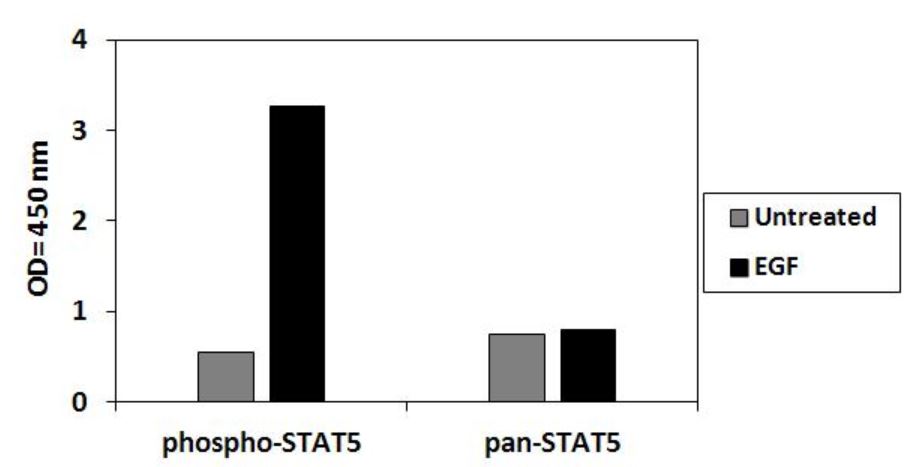
Image 1 of 1
local_shipping
Please allow 3-5 business days for shipment.
Product Description
Signal transducer and activator of transcription 5a (STAT5a) is a member of the STAT family of transcription factors. In response to cytokines and growth factors, STAT family members are phosphorylated by the receptor associated kinases, and then form homo- or heterodimers that translocate to the cell nucleus where they act as transcription activators. This protein is activated by, and mediates the responses of many cell ligands, such as IL2, IL3, IL7 GM-CSF, erythropoietin, thrombopoietin, and different growth hormones [taken from NCBI Entrez Gene (Gene ID: 6776)].
Specifications
Reactivity
Human
Target Identity
Antigen Species
Human
Gene ID6776
Gene Symbol
STAT5A
Gene Name
signal transducer and activator of transcription 5A
Uniprot IDP42229
Protein Name
Signal transducer and activator of transcription 5A
Product Information
Applications
ELISA
Assay Type
Sandwich ELISA
Assay Range
Semi-quantitative
Sample Type
Cell and Tissue Lysates
Detection Method
Biotinylated-Streptavidin-HRP and HRP
Storage Conditions
Store at -20 °C
Shelf Life
6 months from date of receipt
Contents
- Pre-Coated 96-well Strip Plate, 1 each
- Positive Control vial, 1 each
- anti-Pan Detection Antibody
- anti-Phos Detection Antibody
- Assay Diluent
- HRP-conjugated Secondary Antibody
- TMB Substrate, 12 ml
- Stop Solution, 8 ml
- 20X Wash Buffer, 25 ml
- 2X Lysis Buffer, 5ml
Country of Origin
USA
Documents
Product DatasheetPDF · E172-012Open
Services
Antibody Conjugation
Antibody and conjugate formats developed together, built to your specification.
Request CustomizationCustom Monoclonal Antibody Discovery Services
Full custom monoclonal development, from immunization through validation.
Explore Monoclonal DevelopmentVHH Discovery
Single-domain antibodies for structurally difficult targets a conventional monoclonal can't reach.
Explore VHH DiscoveryResources



1