


Bethyl Laboratories
Rabbit anti-BUD13 Antibody Affinity Purified
Primary
Catalog #A303-320A
TargetBUD13
HostRabbit
ClonalityPolyclonal
ReactivityHuman
ApplicationIP
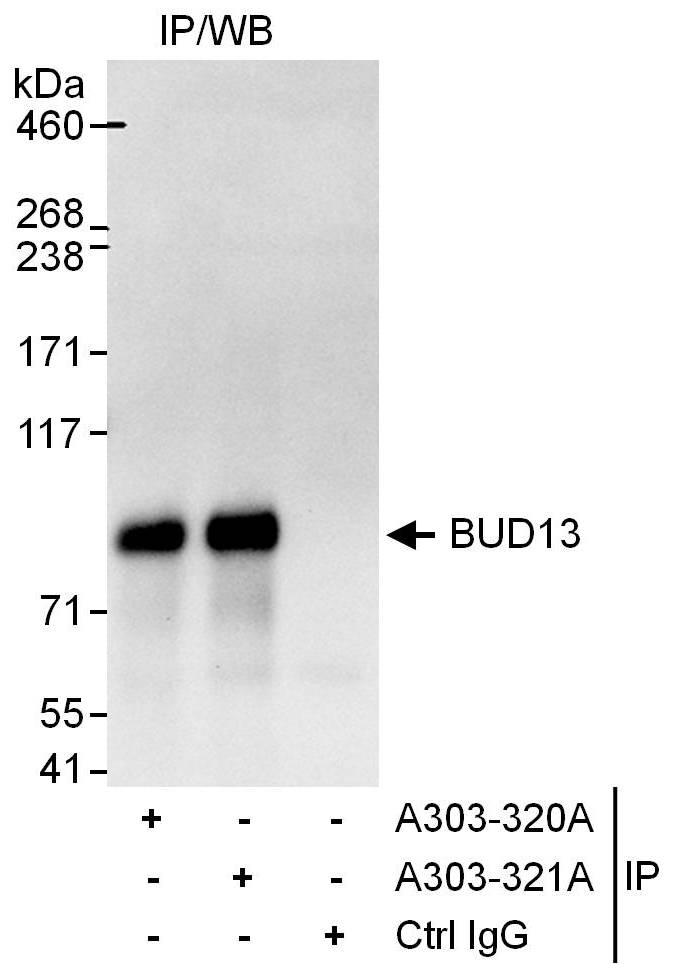
Image 1 of 1
local_shipping
Order within 17 hours and 2 minutes for shipment by Tuesday, November 3
Product Description
BUD13 is an uncharacterized CWC26 family member that may function as a pre-mRNA splicing factor.
Specifications
Clonality
Polyclonal
Host
Rabbit
Immunogen
Between 100 and 150
Isotype
IgG
Reactivity
Human
Format
Whole IgG
Conjugate Type
Unconjugated
Purity
Antigen Affinity Purified
Concentration
1000 µg/ml
Target Identity
TargetBUD13
Antigen Species
Human
Gene ID84811
Gene Symbol
BUD13
Gene Name
BUD13 homolog
Uniprot IDQ9BRD0
Protein Name
BUD13 homolog
Alternate Names
Product Information
Applications
IP
Buffer
Tris-citrate/phosphate buffer, pH 7 to 8 containing 0.09% Sodium Azide
Storage Conditions
2 - 8 °C
Physical State
Liquid
Shelf Life
1 year from date of receipt
Country of Origin
USA
Production & Epitope
Antibody was affinity purified using an epitope specific to BUD13 immobilized on solid support.
The epitope recognized by A303-320A maps to a region between residue 100 and 150 of human BUD13 using the numbering given in entry NP_116114.1 (GeneID 84811).
Immunoglobulin concentration was determined using Beer’s Law where 1mg/mL IgG has an A280 of 1.4.
Applications
All western blot analysis is performed using 5% Milk-TBST for blocking and as antibody diluent. Primary antibody is incubated overnight.
Western blots of immunoprecipitates are performed using an anti-Rabbit IgG Light Chain HRP-conjugated antibody with 5% Normal Pig Serum (Cat. No. S100-020) added to the blocking buffer.
Immunoprecipitation (IP)6 µg/mg lysate
Documents
Product DatasheetPDF · A303-320A · Lot 1 (current lot)Open
Product DatasheetPDF · A303-320A · Lot 1 (current lot)Open
Safety Data SheetPDF · A303-320AOpen
Citations / Publications
Services
Antibody Conjugation
Antibody and conjugate formats developed together, built to your specification.
Request CustomizationCustom Monoclonal Antibody Discovery Services
Full custom monoclonal development, from immunization through validation.
Explore Monoclonal DevelopmentVHH Discovery
Single-domain antibodies for structurally difficult targets a conventional monoclonal can't reach.
Explore VHH DiscoveryResources



1