


Bethyl Laboratories
Rabbit anti-FAM83G Antibody Affinity Purified
Primary
Catalog #A304-281A
TargetFAM83G
HostRabbit
ClonalityPolyclonal
ReactivityHuman
ApplicationIP
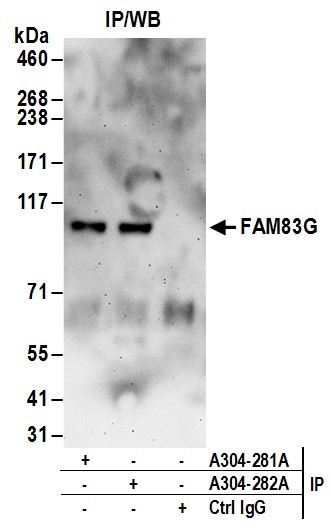
Image 1 of 1
local_shipping
Order within 10 hours and 23 minutes for shipment by today
Product Description
FAM83G is an uncharacterized protein that belongs to the FAM83 family.
Specifications
Clonality
Polyclonal
Host
Rabbit
Immunogen
Between 600 and 650
Isotype
IgG
Reactivity
Human
Format
Whole IgG
Conjugate Type
Unconjugated
Purity
Antigen Affinity Purified
Concentration
1000 µg/ml
Target Identity
TargetFAM83G
Antigen Species
Human
Gene ID644815
Gene Symbol
FAM83G
Gene Name
family with sequence similarity 83 member G
Uniprot IDA6ND36
Protein Name
Protein FAM83G
Alternate Names
Product Information
Applications
IP
Buffer
Tris-citrate/phosphate buffer, pH 7 to 8 containing 0.09% Sodium Azide
Storage Conditions
2 - 8 °C
Physical State
Liquid
Shelf Life
1 year from date of receipt
Country of Origin
USA
Production & Epitope
Antibody was affinity purified using an epitope specific to FAM83G immobilized on solid support.
The epitope recognized by A304-281A maps to a region between residue 600 to 650 of human Family with Sequence Similarity 83, Member G using the numbering given in entry NP_001035088.2 (GeneID 644815).
Immunoglobulin concentration was determined using Beer’s Law where 1mg/mL IgG has an A280 of 1.4.
Applications
All western blot analysis is performed using 5% Milk-TBST for blocking and as antibody diluent. Primary antibody is incubated overnight.
Western blots of immunoprecipitates are performed using an anti-Rabbit IgG Light Chain HRP-conjugated antibody with 5% Normal Pig Serum (Cat. No. S100-020) added to the blocking buffer.
Immunoprecipitation (IP)6 µg/mg lysate
Documents
Product DatasheetPDF · A304-281A · Lot 1 (current lot)Open
Product DatasheetPDF · A304-281A · Lot 1 (current lot)Open
Safety Data SheetPDF · A304-281AOpen
Services
Antibody Conjugation
Antibody and conjugate formats developed together, built to your specification.
Request CustomizationCustom Monoclonal Antibody Discovery Services
Full custom monoclonal development, from immunization through validation.
Explore Monoclonal DevelopmentVHH Discovery
Single-domain antibodies for structurally difficult targets a conventional monoclonal can't reach.
Explore VHH DiscoveryResources



1