



Bethyl Laboratories
Rabbit anti-Papain Antibody Affinity Purified
Primary
Catalog #A150-114A
TargetPapain
HostRabbit
ClonalityPolyclonal
ReactivitySpecies Independent
ApplicationELISA, ICC, IHC, WB

local_shipping
Order within 21 hours and 33 minutes for shipment by Tuesday, November 24
Product Description
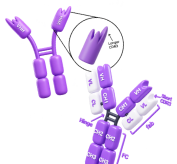
Papain is an enzyme typically utilized over a wide range of commercial applications, including the tenderization of meat. In molecular biology, it can be used to cleave the Fc region from Fab region of an immunoglobulin.
Specifications
Clonality
Polyclonal
Host
Rabbit
Isotype
IgG
Reactivity
Species Independent
Format
Whole IgG
Conjugate Type
Unconjugated
Purity
Antigen Affinity Purified
Concentration
1 mg/ml
Target Identity
TargetPapain
Product Information
Applications
ELISA, ICC, IHC, WB
Buffer
Phosphate Buffered Saline (PBS) containing 0.09% Sodium Azide
Storage Conditions
2 - 8 °C
Physical State
Liquid
Shelf Life
2 years from date of receipt
Country of Origin
USA
Production & Epitope
The antibody was isolated by affinity chromatography using papain coupled to agarose beads. Immunoglobulin concentration was determined using Beer’s Law where 1mg/mL IgG has an A280 of 1.4.
By immunoelectrophoresis and ELISA this antibody reacts specifically with Papain.
Applications
Not all listed applications have been specifically tested by our laboratory.
Enzyme-Linked Immunosorbent Assay (ELISA)1:1000 - 1:30,000; for coating plates 1:100 - 1:500
Immunocytochemistry (ICC)1:200 - 1:2000
Immunohistochemistry (IHC)1:200 - 1:2000
Western Blot (WB)1:1000 - 1:30,000
Documents
Safety Data SheetPDF · A150-114AOpen
Product DatasheetPDF · A150-114A · Lot 2 (current lot)Open
Services
Antibody Conjugation
Antibody and conjugate formats developed together, built to your specification.
Request CustomizationCustom Monoclonal Antibody Discovery Services
Full custom monoclonal development, from immunization through validation.
Explore Monoclonal DevelopmentVHH Discovery
Single-domain antibodies for structurally difficult targets a conventional monoclonal can't reach.
Explore VHH DiscoveryResources



1