



Bethyl Laboratories
Rabbit anti-vPARP IHC Antibody Affinity Purified
Primary
Catalog #IHC-00580
TargetvPARP
HostRabbit
ClonalityPolyclonal
ReactivityHuman
ApplicationIHC
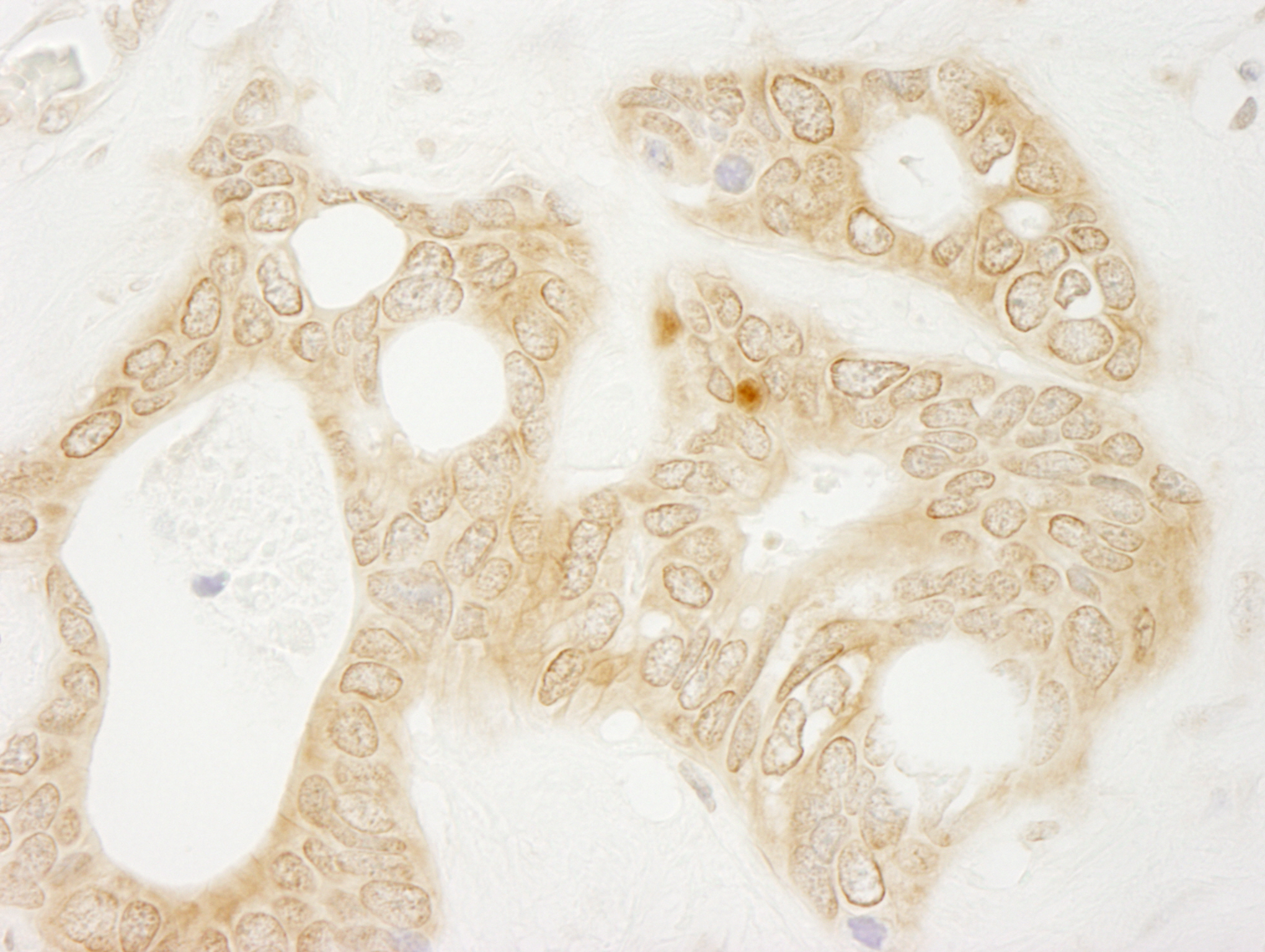
Image 1 of 1
local_shipping
Order within 8 hours and 26 minutes for shipment by today
Product Description
PARP4 [poly(ADP-ribose) polymerase family, member 4] catalyzes the formation of ADP-ribose polymers covalently attached to proteins using NAD+ as a substrate. There are 6 mammalian PARP enzymes: PARP1, PARP2, PARP3, PARP4/vPARP, PARP5/Tankyrase-1, and PARP6/Tankyrase-2. PARP4 is also known as vault PARP (vPARP) due to its association with the vault particle, a 13MDa cytoplasmic ribonucleoprotein complex whose barrel-shaped structure resembles arched cathedral ceilings. vPARP has also been identified separate from the vault particle. It has been localized to the nuclear pore, mitotic spindle, and cytoplasm. It also has been shown to associate with telomerase activity. Studies of vPARP knockout mice show an increased susceptibility to carcinogen-induced tumorigenesis.
Specifications
Clonality
Polyclonal
Host
Rabbit
Immunogen
Between 1674 and C-terminus
Isotype
IgG
Reactivity
Human
Format
Whole IgG
Conjugate Type
Unconjugated
Purity
Antigen Affinity Purified
Concentration
250 µg/ml
Target Identity
TargetvPARP
Antigen Species
Human
Gene ID143
Gene Symbol
PARP4
Gene Name
poly(ADP-ribose) polymerase family member 4
Uniprot IDQ9UKK3
Protein Name
Poly [ADP-ribose] polymerase 4
Alternate Names
193 kDa vault protein • ADP-ribosyltransferase (NAD+ • poly (ADP-ribose) polymerase)-like 1 • ADP-ribosyltransferase diphtheria toxin-like 4 • ADPRTL1 • ARTD4 • H5 proline-rich • I-alpha-I-related • p193 • PARP-4 • PARPL • PARP-related • PARP-related/IalphaI-related H5/proline-rich • PH5P • poly ADP-ribose polymerase 4 • poly(ADP-ribose) synthetase • poly(ADP-ribosyl)transferase-like 1 • vault poly(ADP-ribose) polymerase • vault protein, 193-kDa • VAULT3 • von Willebrand factor A domain containing 5C • VPARP • VWA5C
Product Information
Applications
IHC
Buffer
Tris-buffered Saline containing 0.1% BSA and 0.09% Sodium Azide
Storage Conditions
2 - 8 °C
Physical State
Liquid
Shelf Life
1 year from date of receipt
Country of Origin
USA
Production & Epitope
Antibody was affinity purified using an epitope specific to vPARP immobilized on solid support.
The epitope recognized by IHC-00580 maps to a region between residue 1674 to 1724 of human vault poly(ADP-ribose) polymerase using the numbering given in entry NP_006428.2 (GeneID 143).
Immunoglobulin concentration was determined using Beer’s Law where 1mg/mL IgG has an A280 of 1.4.
Applications
Epitope exposure is recommended.
Epitope exposure with citrate buffer or tris-EDTA pH9.0 buffer will enhance staining.
Likely to work with frozen sections.
In some cases, the antibody may be diluted further than indicated.
Immunohistochemistry (IHC)1:100 - 1:500
Documents
Safety Data SheetPDF · IHC-00580Open
Product DatasheetPDF · IHC-00580 · Lot 1 (current lot)Open
Product DatasheetPDF · IHC-00580 · Lot 1 (current lot)Open
Services
Antibody Conjugation
Antibody and conjugate formats developed together, built to your specification.
Request CustomizationCustom Monoclonal Antibody Discovery Services
Full custom monoclonal development, from immunization through validation.
Explore Monoclonal DevelopmentVHH Discovery
Single-domain antibodies for structurally difficult targets a conventional monoclonal can't reach.
Explore VHH DiscoveryResources



1